
Prerequisites for Masters in Business Analytics in the USA
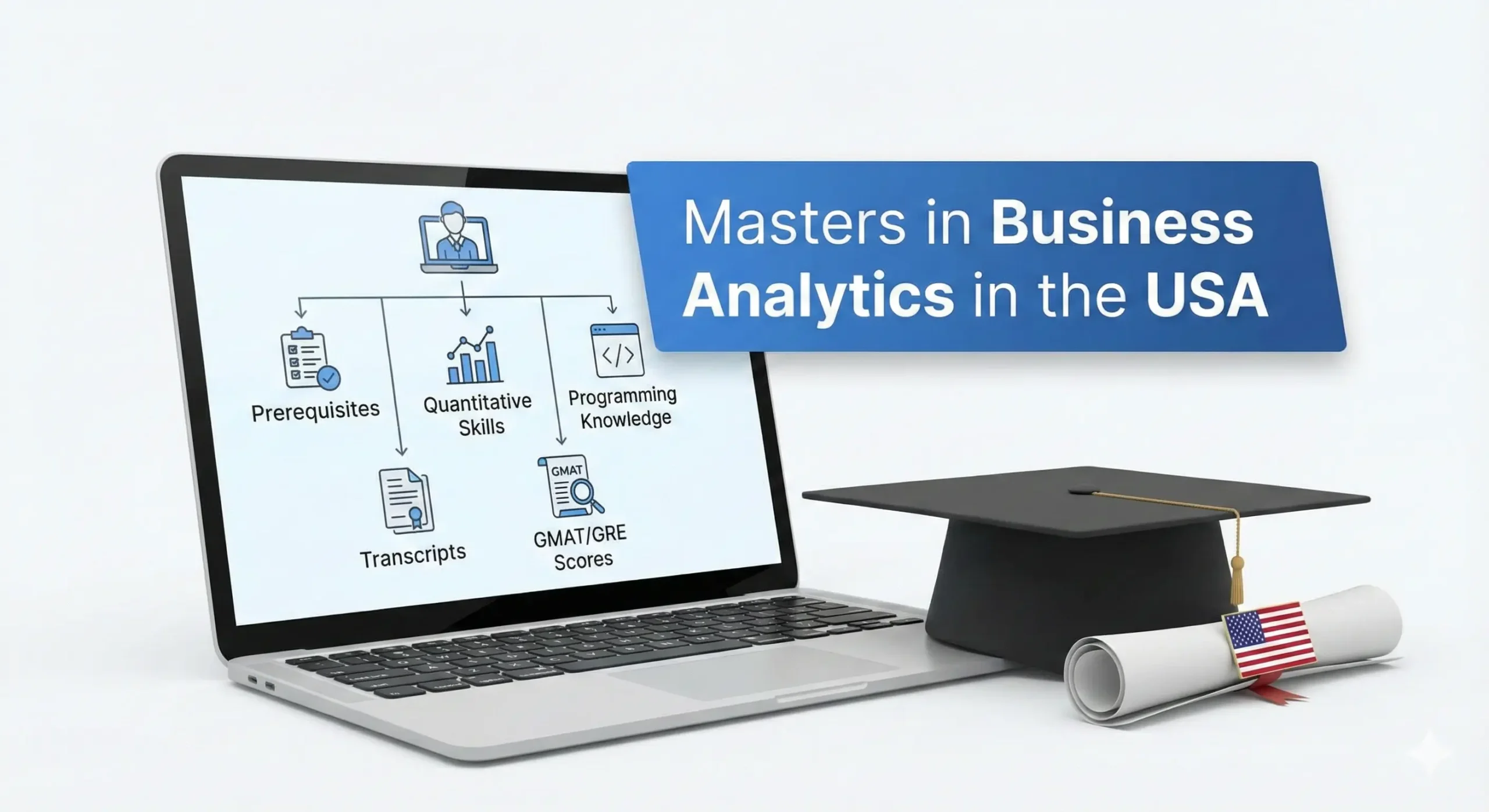
Planning to study Masters in Business Analytics (MSBA) in USA but confused about eligibility and requirements? You are not alone. Many students apply without fully understanding the pre requrements, and that’s one of the biggest reasons for rejection.
In this blog, I’ll explain everything you actually need to apply for MS in Business Analytics in the USA, with real clarity, not complicated terms.
This guide is written just like a real student advice blog, so you can read it comfortably and take action.
What is a Masters in Business Analytics?
Business Analytics is all about using data to make better business decisions. Companies are today collect huge amounts of data, but they need skilled people who can understand that data and turn it into useful insights.
After MS in Business Analytics, students usually work as:
- Business Analysts
- Data Analysts
- Business Intelligence Analysts
- Analytics Consultants
Because of this strong demand, USA universities want students who are ready To analytics learning, not just students with higher marks.
Basic Education Requirement First and Most Important
To apply for MS in Business Analytics in the USA, you must have a bachelor’s degree.
Most universities accept students from:
- BBA / BMS
- B.Com / Commerce
- Engineering (any branch)
- Computer Science / IT
- Economics
- Mathematics / Statistics
The good news is that your degree title are matters less than your skills. Even non-technical students get admission if they prepare their profile properly.
Minimum Marks / GPA
Most universities ask for:
- Around 60–65% (3.0 GPA out of 4.0)
- Top universities prefer 70% or above
If your marks are average, don’t worry. Universities also look at skills, SOP, projects, and certifications.
Math and Statistics
This is where many students panic. Business Analytics involves numbers, so universities expect basic comfort with mathematics and statistics.
You don’t need advanced maths. You should at least understand:
- Basic statistics
- Probability
- Data interpretation
- Simple algebra
If your graduation didn’t include maths, you can still apply. Many students cover this gap by doing online courses before applying.
Do You Need Programming Knowledge?
This is one of the most common questions.
The honest answer:
Programming is not compulsory, but basic knowledge helps a lot.
Universities like students who have exposure to:
- Excel (very important)
- SQL (highly preferred)
- Python or R (basic level)
- Tableau or Power BI
You don’t need to be an expert. Even beginner-level knowledge shows that you are serious about analytics.
English Language Requirement
Since the course is taught in English, you must prove your language ability.
Most universities accept:
- IELTS
- TOEFL
- Duolingo
Here is a general idea:
| Exam | Typical Minimum Score |
|---|---|
| IELTS | 6.5 – 7.0 |
| TOEFL | 80 – 100 |
| Duolingo | 105 – 120 |
Some universities are English tests if your previous education was fully in English, but that depends on the every university.
GRE or GMAT – Is It Required?
This depends on the university.
Many US universities:
- Do NOT require GRE or GMAT
- Keep it optional
- Waive it completely
However, GRE or GMAT can help if:
- Your GPA is low
- You don’t have a strong math background
- You are applying to top universities
- You want scholarships
A good quantitative score is more important than the total score.
Work Experience – Helpful but Not Mandatory
Work experience is not compulsory for MS in Business Analytics.
But it is definitely a plus point, especially if it is related to:
- Data analysis
- Business operations
- IT or software
- Finance, marketing, or consulting
Even internships, live projects, or freelance work add value. Universities like students who understand real-world business problems.
Statement of Purpose (SOP)
Your SOP can make or break your application.
In simple words, your SOP should explain:
- Why you chose Business Analytics
- How your background connects to analytics
- Why you want to study in the USA
- Your career goals after graduation
A strong SOP can cover weaknesses like low marks or lack of experience. This is where you talk like a human, not like a robot.
Letters of Recommendation
Most universities ask for 2 or 3 recommendation letters.
They can be from:
- College professors
- Managers or supervisors
- Internship mentors
Good LORs talk about your:
- Analytical thinking
- Learning ability
- Discipline
- Problem-solving skills
Resume and Profile Strength
Your resume should be clean and simple, not fancy.
It should include:
- Education details
- Skills (Excel, SQL, Python, etc.)
- Projects related to analytics
- Internships or work experience
- Certifications
One strong project is better than five weak ones.
Certifications and Projects
Many successful students do certifications before applying.
Popular options include:
- Google Data Analytics
- IBM Business Analytics
- Excel or SQL courses
- Tableau / Power BI training
These show universities that you are serious and prepared.
Final Thoughts
To apply for Master’s in Business Analytics in the USA, you don’t need a perfect profile. You need a balanced profile.
What matters most is:
- Basic quantitative understanding
- Willingness to learn analytics
- Clear career goals
- Honest and well-written SOP
If you prepare smartly, even an average student can get into a good US university.